What do the four readings tell you?
The four readings use different units. Oxygen is reported as percent by volume, while CO and H₂S are reported in parts per million (ppm). The combustible-gas scale is a percentage of the lower explosive limit (LEL) of the calibration gas. [S1] These readings answer different questions, so one cannot stand in for another.
| Reading | What the reading answers | What the reading does not answer |
|---|---|---|
| Oxygen (O₂), % vol | Whether the air is oxygen-deficient or oxygen-enriched. | Which gas displaced the oxygen, or how much CO₂ is present. See the CO₂ section. |
| Carbon monoxide (CO), ppm | The current CO concentration at the sensor. | A time-weighted average, unless the instrument calculates one over a stated period. |
| Hydrogen sulfide (H₂S), ppm | The current H₂S concentration at the sensor. | How a recorded peak relates to a TWA. See the H₂S peak and TWA record guide. |
| Combustible gas, %LEL | Flammability relative to the LEL of the calibration gas. | Toxic exposure to the same vapor. See the solvent section. |
For CO and H₂S, a current reading and an exposure average describe different things. A peak shows a concentration reached during monitoring; a time-weighted average includes how long the concentration persisted. [S2] That distinction matters when an instrument records a brief high reading but a much lower average. The H₂S peak and TWA record guide works through that comparison.
Before comparing an exposure limit with a reading, identify the time period each represents. The US references below distinguish a time-weighted average (TWA), a short-term exposure limit (STEL) and a ceiling. [S2] Those references are not proposed factory alarm settings.
- TWA: a time-weighted average over a stated period. [S2]
- STEL: a short-term average, usually over 15 minutes. [S2]
- Ceiling: a value that should not be exceeded at any time. [S2]
For BTYQ-MS104K-M and BTYQ-MS400-S, our specifications list low, high, range and TWA/STEL alarm modes. [S3] The supplied modes and set points belong in the quotation, with the gas combination and measuring ranges. Alarm settings must follow the applicable jurisdiction and site program; the mode list alone does not establish those settings.
How do measuring range and accuracy affect the CO reading?
Choose a CO range that covers the concentrations the job requires, then assess accuracy near the readings used for alarms or exposure assessment. A wider range can cover higher concentrations, but it does not necessarily give the same absolute error at low concentrations. Our model documents list the following gas and range options for BTYQ-MS104K-M and BTYQ-MS400-S. [S4]
| Measurement | Measuring range | Display resolution |
|---|---|---|
| Oxygen (O₂) | 0–30% vol | 0.01% vol |
| Carbon monoxide (CO) | 0–100 ppm | 0.01 ppm |
| Carbon monoxide (CO) | 0–1000 ppm | 0.1 ppm |
| Hydrogen sulfide (H₂S) | 0–10 ppm | 0.01 ppm |
| Hydrogen sulfide (H₂S) | 0–100 ppm | 0.01 ppm |
| Combustible gas | 0–100%LEL | 0.1%LEL |
Sources: [S4].
The difference is easy to see when accuracy is expressed as a percentage of full scale (FS), the upper end of the measuring range. Our specification table gives a typical accuracy of ±3%FS, with higher-accuracy sensors available as an option. [S3] At that rating, 0–100 ppm gives an absolute tolerance of ±3 ppm, while 0–1000 ppm gives ±30 ppm. [S3; calculation] Display resolution is the smallest displayed step; extra decimal places do not reduce that tolerance.
NIOSH recommends 35 ppm as a CO TWA and 200 ppm as a ceiling. The OSHA permissible exposure limit is 50 ppm as a TWA. [S5] The narrower range reduces the calculated error at the same %FS rating, but cannot cover a 200 ppm event. The choice therefore depends on both required coverage and the applicable error specification.
Our CO type-evaluation reports give a different error statement: a maximum permissible error (MPE) of ±5 μmol/mol or ±10% for the 0–1000 μmol/mol configuration. [S6] [S7] Those reports record tests at 150, 300 and 700 μmol/mol, rather than near 35 ppm. They provide evidence for the wider range under the reported laboratory conditions, but do not establish its error at every lower concentration.
| Error statement | Range | What is established near 35 ppm? | Conditions and limits |
|---|---|---|---|
| Specification table, typical ±3%FS | 0–100 ppm | ±3 ppm | Typical value; test conditions not stated. Cannot read a 200 ppm ceiling event. |
| Specification table, typical ±3%FS | 0–1000 ppm | ±30 ppm | Typical value; test conditions not stated. |
| Type-evaluation MPE: ±5 μmol/mol or ±10% | 0–1000 μmol/mol | Not tested near 35 ppm. The report states ±5 μmol/mol or ±10%. | Three units per model tested at 150, 300 and 700 μmol/mol. BTYQ-MS104K-M: 20–24 °C, 35–55 %RH. BTYQ-MS400-S: 21–23 °C, 55 %RH. |
Sources: [S3] [S6] [S7]. Calculated values use the method and assumptions given in the text.
Across the reported CO test points, the results ranged from −1.7% to +5.3% of the reference gas. [S6] [S7] The tests covered 20–24 °C, whereas our typical operating range is −20 to +55 °C and 10–95 %RH. [S3] [S6] [S7] A purchase specification that depends on a low CO reading at another temperature needs performance evidence for that condition.
The calculator below answers a narrower question: which listed ranges satisfy a chosen concentration and error requirement if the stated %FS figure applies? With a rating of ±q%FS, the range must satisfy Cmax ≤ FS ≤ 100 × E ÷ q. Here Cmax is the highest required concentration and E is the permitted absolute error in ppm. [S3; calculation]
Interactive check
Compare range, resolution and error
- 0–100 ppmResolution 0.01 ppm±3 ppm
- 0–1000 ppmResolution 0.1 ppm±30 ppm
Arithmetic screen: 80 ≤ FS ≤ 166.67 ppm. Listed range meeting both conditions: 0–100 ppm. Confirm the applicable accuracy specification before acceptance.
This screen applies the selected %FS rating to the listed ranges. A different documented accuracy specification needs a separate assessment.
For example, covering 200 ppm while limiting absolute error to ±5 ppm gives no solution at ±3%FS. [S3; calculation] That result rules out the stated %FS specification for the task; it does not rule out a different documented accuracy specification. Any alternative still needs evidence for the concentration and conditions required by the job.
Can a low %LEL reading rule out harmful solvent exposure?
A low %LEL reading cannot establish that solvent exposure is acceptable, because flammability and toxic exposure occur at different concentrations. For n-hexane, NIOSH lists an LEL of 1.1% by volume and a recommended exposure limit (REL) of 50 ppm as a TWA. [S8] Using that LEL, even 1%LEL corresponds to 110 ppm. [S8; calculation] A small reading on the flammability scale can therefore exceed the exposure reference.
| Value | Concentration | What the value describes |
|---|---|---|
| 10%LEL of n-hexane | 1,100 ppm | Flammability, by gas-property conversion; not a detector reading |
| NIOSH IDLH | 1,100 ppm | Immediately dangerous to life or health |
| NIOSH REL | 50 ppm TWA | Recommended exposure limit over a workday |
Sources: [S8]. Calculated values use the method and assumptions given in the text.
At 10%LEL, the calculated n-hexane concentration reaches 1,100 ppm, the NIOSH immediately dangerous to life or health (IDLH) value. [S8; calculation] OSHA 29 CFR 1910.146 also defines a flammable atmosphere above 10% of the lower flammable limit as hazardous in covered permit spaces. [S9] Staying below that flammability boundary does not demonstrate control of toxic exposure.
There is a second distinction: converting a gas property is not the same as predicting an instrument reading. Our %LEL type evaluations used methane; the BTYQ-MS400-S test configuration used a catalytic sensor with an MPE of ±5%FS. [S10] [S11] A sensor calibrated with methane needs its own response data for other combustible gases. [S1] The selector below changes the LEL reference in the calculation, without modelling that sensor response.
Interactive check
Same %LEL, different volume concentration
- Example reading
- 10%LEL
- Volume concentration
- 0.5% vol
- Parts per million
- 5,000 ppm
- Methane 5% vol LEL → 5,000 ppm at 10%LEL
- Propane 2.1% vol LEL → 2,100 ppm at 10%LEL
- n-Hexane 1.1% vol LEL → 1,100 ppm at 10%LEL
Gas-property conversion only. It does not predict the response of a sensor calibrated on another gas, provide a correction factor or set an alarm.
The conversion uses the published LEL references for methane, propane and n-hexane. [S12] [S13] [S8] For an n-hexane application, the flammability requirement and the exposure requirement should therefore remain separate in the enquiry.
| Requirement | Include in the enquiry | Evidence needed for the offered instrument |
|---|---|---|
| Flammability | n-Hexane, %LEL scale and calibration gas. | Sensor-specific response to n-hexane; a gas-property conversion is not enough. |
| Exposure | n-Hexane in ppm, the applicable limit and its averaging period. | A ppm-level measurement method with matching performance data; a general “VOC” label is not enough. |
Sources: [S1].
Our documents list VOC ranges from 0–20 ppm to 0–10,000 ppm, and both models have a built-in gas library. [S3] [S4] Those features alone do not establish n-hexane performance: selection still needs the offered sensor’s response data and the required ppm range. On BTYQ-MS104K-M, a PID measurement and %LEL also compete for the same documented sensor position. [S3] That combination limit affects the model choice when both measurements are needed.
Why does a normal oxygen reading not rule out CO₂?
An O₂ sensor measures oxygen, so its reading cannot tell you how much CO₂ is present. If oxygen-free CO₂ mixes uniformly with air initially containing 20.9% vol O₂, the oxygen fraction falls as the air is displaced. The calculation is O₂ = 20.9 × (1 − CO₂ fraction). [Calculation] At 3% vol CO₂, the resulting O₂ reading is still 20.27% vol.
| CO₂ in the mixture | Calculated O₂ reading | US reference at that CO₂ level |
|---|---|---|
| 0.5% vol (5,000 ppm) | 20.80% vol | NIOSH REL and OSHA PEL: TWA 5,000 ppm |
| 3.0% vol (30,000 ppm) | 20.27% vol | NIOSH short-term REL: 30,000 ppm |
| 4.0% vol (40,000 ppm) | 20.06% vol | NIOSH IDLH: 40,000 ppm |
| 6.7% vol (67,000 ppm) | 19.50% vol | Above the IDLH; O₂ reaches the 19.5% vol boundary in OSHA 29 CFR 1910.146 |
At the NIOSH CO₂ IDLH of 40,000 ppm, the same calculation gives 20.06% vol O₂. [S14; calculation] That is above the 19.5% vol oxygen-deficiency boundary in OSHA 29 CFR 1910.146 for covered permit spaces. [S9] This example explains the blind spot; uniform mixing and oxygen-free CO₂ are calculation assumptions, not a prediction of a particular release.
Where CO₂ is a hazard, a separate CO₂ measurement is needed. Range selection then follows the same coverage-and-error question as CO: which concentrations must the instrument read, and how accurate must those readings be? Our documents list the following CO₂ options. [S3] [S4]
| CO₂ range | Highest US reference within the range |
|---|---|
| 0–5,000 ppm | TWA 5,000 ppm, at full scale; the short-term REL and IDLH are above the range |
| 0–50,000 ppm | Short-term REL 30,000 ppm and IDLH 40,000 ppm |
| 0–5% vol | IDLH 40,000 ppm (4% vol) |
| 0–100% vol | All three references; check the error that applies near your decision value |
The 0–5,000 ppm option reaches the NIOSH TWA reference only at full scale, while the short-term and IDLH references lie above it. [S4] [S14] A range that reaches 40,000 ppm covers those higher reference concentrations, but range coverage alone does not establish accuracy. The next section explains why adding CO₂ to O₂/CO/H₂S/%LEL also depends on the model’s sensor arrangement.
Which model and sampling arrangement fit the job?
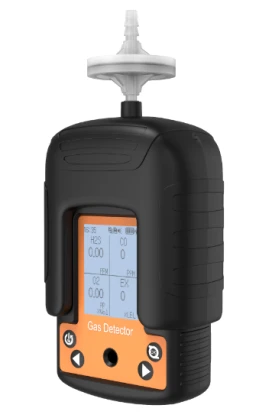
For monitoring where gas can reach the instrument, both models support diffusion sampling. For a remote sample, BTYQ-MS104K-M uses an attached external pump, while BTYQ-MS400-S has a built-in pump that can be switched off for diffusion. [S3] Choose between those arrangements after deciding where the sample must come from and which gases must be measured together.
BTYQ-MS104K-M: diffusion with an external pump
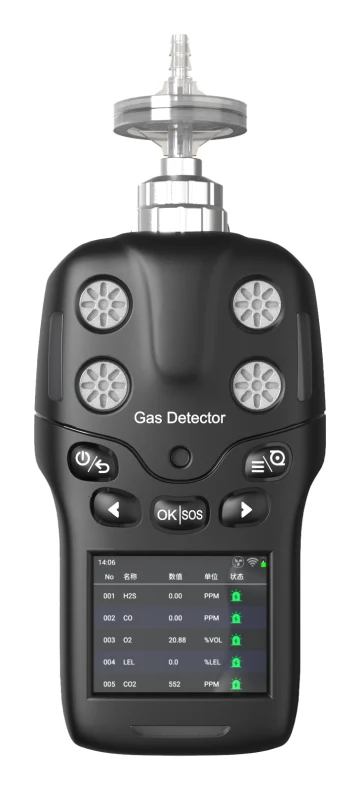
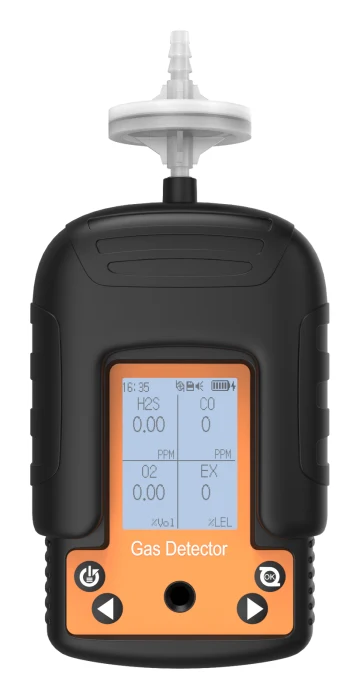
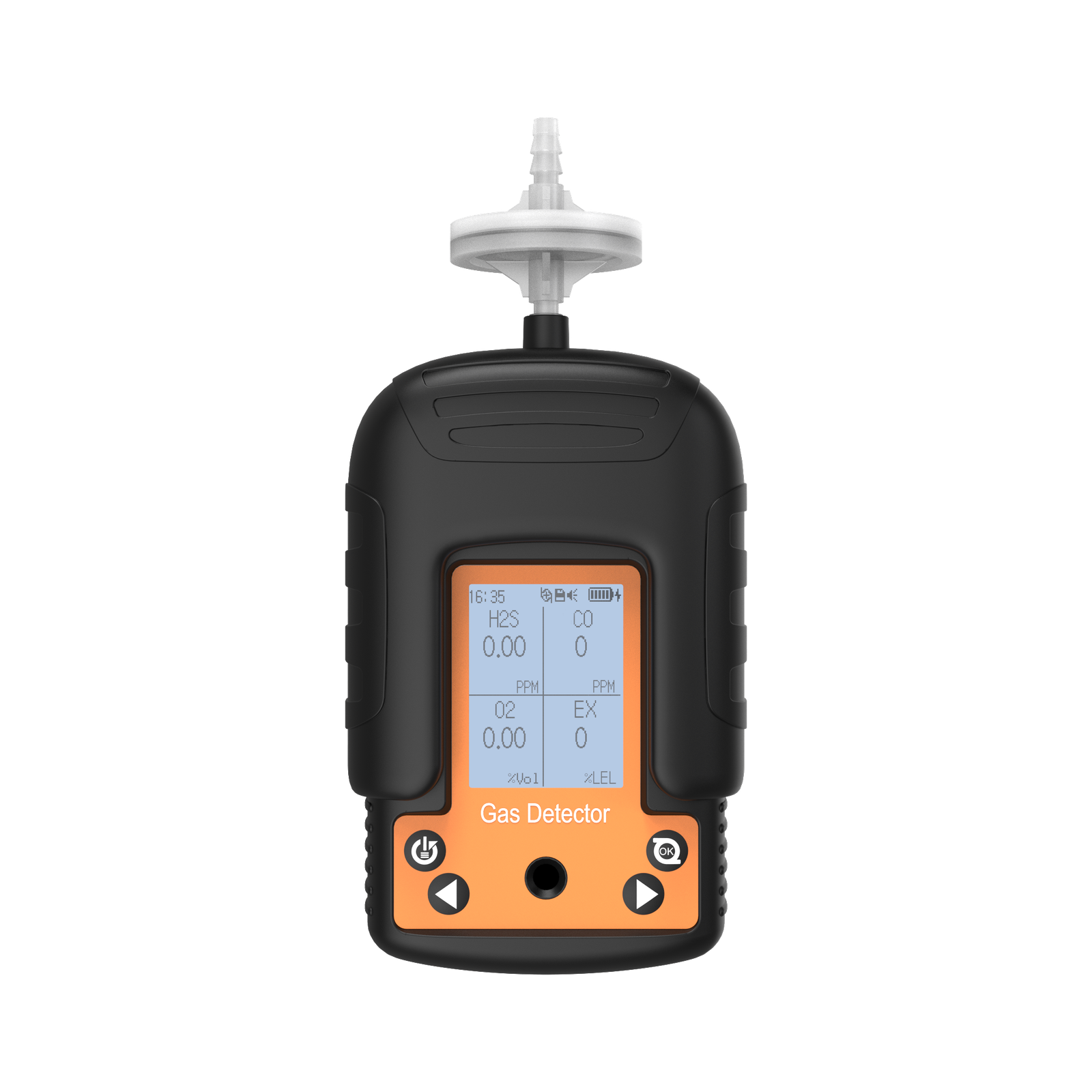
The standard accessories include an external pump and a filter. [S3] The MB20A pump identified in the type-evaluation report is rated at 500 mL/min. [S11] The photographs show the instrument by itself and with the pump attached.
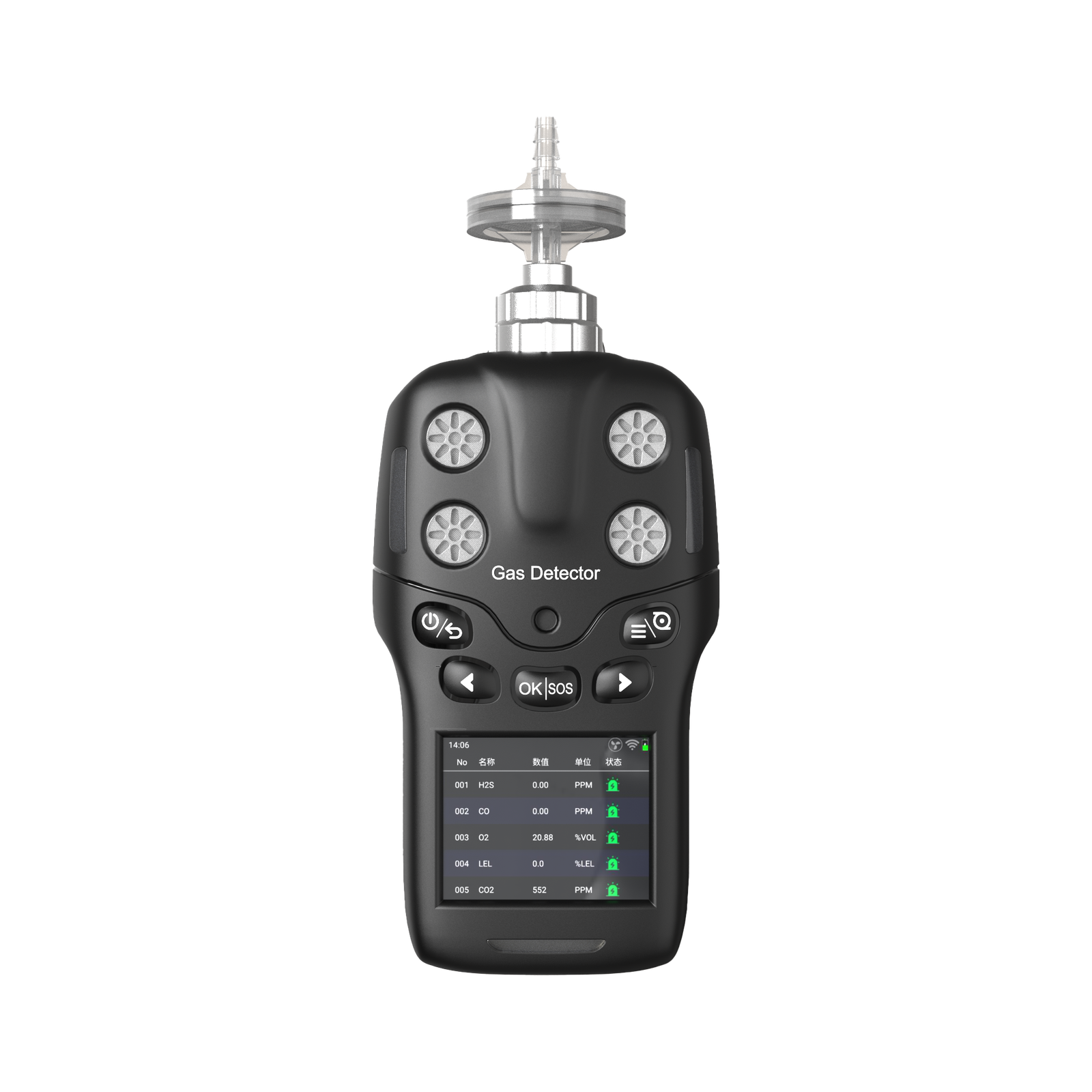
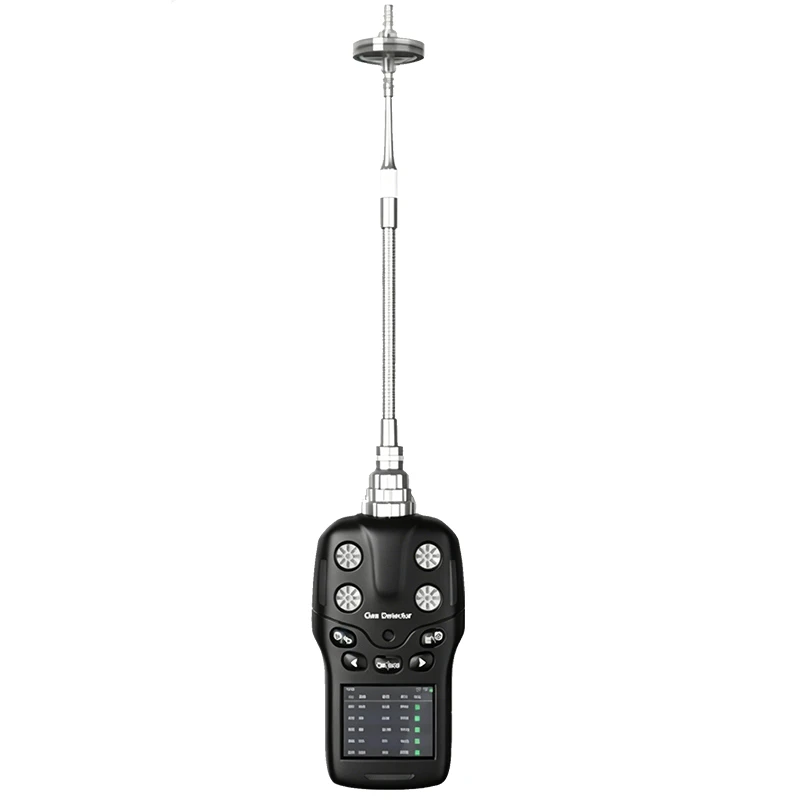
BTYQ-MS400-S: built-in pump with diffusion mode
The built-in pump is rated at 0.5–1 L/min with at least 10 flow levels. Standard accessories include a 0.2 m gooseneck sampling probe and a filter. [S3] Both models also offer a 0.6 m stainless-steel handle or a 0.9 m telescopic handle, each with 1 m of hose. [S3]
Gas combinations can decide the model before sampling does
Our specification table describes both models as configurable for one to four gases, with expansion to five or six. [S3] It also gives different sensor-combination rules. A supported gas range is therefore not enough to establish that all required gases can be measured together.
| Model | Documented combinations | What this means for O₂ + CO + H₂S + %LEL |
|---|---|---|
| BTYQ-MS104K-M | One EX, CO₂, PID or infrared sensor plus three electrochemical sensors; or four electrochemical sensors; or CO/H₂S plus three other gases. | The %LEL sensor uses the single EX, CO₂, PID or infrared position. Adding CO₂ or a PID measurement is outside the documented combinations. |
| BTYQ-MS400-S | Plug-in digital sensors, automatically identified, in any combination. | A fifth measurement such as CO₂ is an expanded configuration; we confirm it in the quotation. |
Sources: [S3].
For O₂/CO/H₂S/%LEL plus CO₂, BTYQ-MS104K-M is outside the documented combinations because CO₂ and %LEL use the same sensor position. [S3] BTYQ-MS400-S is the model to evaluate for that five-gas requirement; the exact combination and CO₂ range still need confirmation in the quotation. The same reasoning applies when solvent exposure requires a PID measurement alongside %LEL.
Compare runtime for the configuration you will use
The more-than-100-hour figure for BTYQ-MS104K-M applies to diffusion operation without catalytic, infrared or PID sensors. [S3] It therefore cannot establish runtime for an O₂/CO/H₂S/%LEL configuration. BTYQ-MS400-S is documented at more than 20 hours in pumped operation. [S3] Because the two figures describe different loads, the quotation needs runtime for the proposed gas configuration and sampling mode.
Allow for the complete sampling path
A pump’s flow rating does not establish how quickly the complete kit will detect a target gas. The type-evaluation reports contain measured response times for the tested configurations and modes, as shown below. [S6] [S7] [S10] T90 means the time to reach 90% of the final reading.
| Model and gas | Sampling mode in the test | Measured response time |
|---|---|---|
| BTYQ-MS104K-M, CO 0–1000 μmol/mol | Diffusion | 13–14 s average, three units |
| BTYQ-MS400-S, CO 0–1000 μmol/mol | Pumped | 10–11 s average, three units |
| BTYQ-MS400-S, methane 0–100%LEL | Pumped | 8–10 s average, three units |
These results were measured at 20–24 °C and do not include an added remote-sampling hose. [S6] [S7] [S10] For remote sampling, the waiting time must account for the target gas, handle, hose and filters together. A complete-path response result addresses that question; the laboratory response figure alone does not.
The personal gas monitoring guide compares worn and remote monitoring, kit weight and runtime, and pre-use checks. For tubing, filters and sample conditioning, use the wastewater sample-handling guide. Those checks follow from the sampling path selected here.
Which explosion-protection record applies to the offered detector?
The approval question concerns the model and version being supplied, not the brand as a whole. The Chinese GB/T records below identify BTYQ-MS104K-M and BTYQ-MS400-S separately. Both carry Ex ia IIC T4 Ga, with an X suffix indicating special conditions. [S15] [S16] Those conditions need to be included in the project’s certificate review.
| Model | Certificate and gas-atmosphere marking | Scope to keep |
|---|---|---|
| BTYQ-MS104K-M | CCRI 24.2941X: Ex ia IIC T4 Ga. | The identified version only; carry the X special conditions into your document review. |
| BTYQ-MS400-S | CCRI 25.2157X: Ex ia IIC T4 Ga. | The identified version only; carry the X special conditions into your document review. |
Neither of these records is an ATEX, IECEx or US approval. [S15] [S16] We hold other explosion-protection records with different markings, each limited to its own scope. The RFQ should name the required approval scheme so the offered model and configuration can be matched to the relevant record. A company management-system certificate cannot replace that product-level evidence.
What should I send with a configuration enquiry?
A useful enquiry identifies which gases must be measured together, each range and the permitted error. It also describes the sampling path. Add the required operating period and approval scheme so we can propose a configuration and identify the supporting records. Unknown requirements can remain open.
Enquiry worksheet
Prepare a configuration enquiry
| Required gas | Range and unit | Permitted error / time basis | Must be measured with | Evidence still needed |
|---|---|---|---|---|
Entries stay in this page. Preparing text does not submit an enquiry.
Preparing text keeps the entries on this page. Copy the result into your RFQ when ready; no enquiry is submitted here.
Copy the worksheet into the configuration RFQ, or use the gas detector quotation checklist for the remaining order details. The BTYQ-MS104K-M product page and BTYQ-MS400-S product page provide the model specifications to review alongside the proposed combination.
Frequently asked questions
References
Bracketed numbers in the text link to these sources. The four type-evaluation reports are available below as Chinese-language PDFs. Other Eranntex records are available on request; public reference sources link to the issuing body.
| Ref. | Source | What it supports |
|---|---|---|
| S1 | OSHA Technical Manual, Section II, Chapter 3 | US guidance on direct-reading instruments; %LEL of the calibration gas. |
| S2 | NIOSH Pocket Guide: Introduction | Definitions of TWA, STEL and ceiling. |
| S3 | Eranntex product specification table, 2026-06-15 edition. Published values also appear on the BTYQ-MS104K-M and BTYQ-MS400-S product pages. | Configurations, typical accuracy, sampling, accessories and runtime, with their recorded conditions. |
| S4 | Eranntex model documents: gas-range appendices (Eranntex record). | Single gas-and-range options; not confirmed gas combinations. |
| S5 | NIOSH Pocket Guide: Carbon monoxide | REL, ceiling and OSHA PEL with their averaging periods. |
| S6 | Type-evaluation report HYQ202538502, Guangdong Institute of Metrology, 2025-02-20 (PDF, Chinese). | BTYQ-MS104K-M, CO 0–1000 μmol/mol: three units, 20–24 °C, diffusion; laboratory result. |
| S7 | Type-evaluation report HYQ202538544, Guangdong Institute of Metrology, 2026-01-22 (PDF, Chinese). | BTYQ-MS400-S, CO 0–1000 μmol/mol: three units, 21–23 °C, pumped; laboratory result. |
| S8 | NIOSH Pocket Guide: n-Hexane | REL, IDLH and LEL; not a sensor response factor. |
| S9 | OSHA 29 CFR 1910.146 | Hazardous-atmosphere definitions for covered US permit spaces. |
| S10 | Type-evaluation report HYQ202538576, Guangdong Institute of Metrology, 2026-01-26 (PDF, Chinese). | BTYQ-MS400-S, methane 0–100%LEL: catalytic sensor, three units, 20–22 °C. |
| S11 | Type-evaluation report F24-164-JJ (PDF, Chinese). | BTYQ-MS104K-M, methane 0–100%LEL; lists the MB20A external pump rated 500 mL/min. |
| S12 | NIOSH: Methane monitoring during roof bolting | Methane LEL of 5% by volume, used for conversion only. |
| S13 | NIOSH Pocket Guide: Propane | Propane LEL of 2.1% by volume, used for conversion only. |
| S14 | NIOSH Pocket Guide: Carbon dioxide | REL, short-term REL, OSHA PEL and IDLH. |
| S15 | Certificate CCRI 24.2941X (PDF) | Chinese GB/T explosion-protection certificate for BTYQ-MS104K-M; identified version and X conditions only. |
| S16 | Certificate CCRI 25.2157X (PDF) | Chinese GB/T explosion-protection certificate for BTYQ-MS400-S; identified version and X conditions only. |