Skip to content
Industrial gas detection for demanding environments

Solution

Wireless Area Gas Monitoring & Early Warning System

Connect compatible portable and fixed detectors across temporary, remote or difficult-to-wire sites, coordinate field alarms and bring device status and monitoring data into a shared operational view.

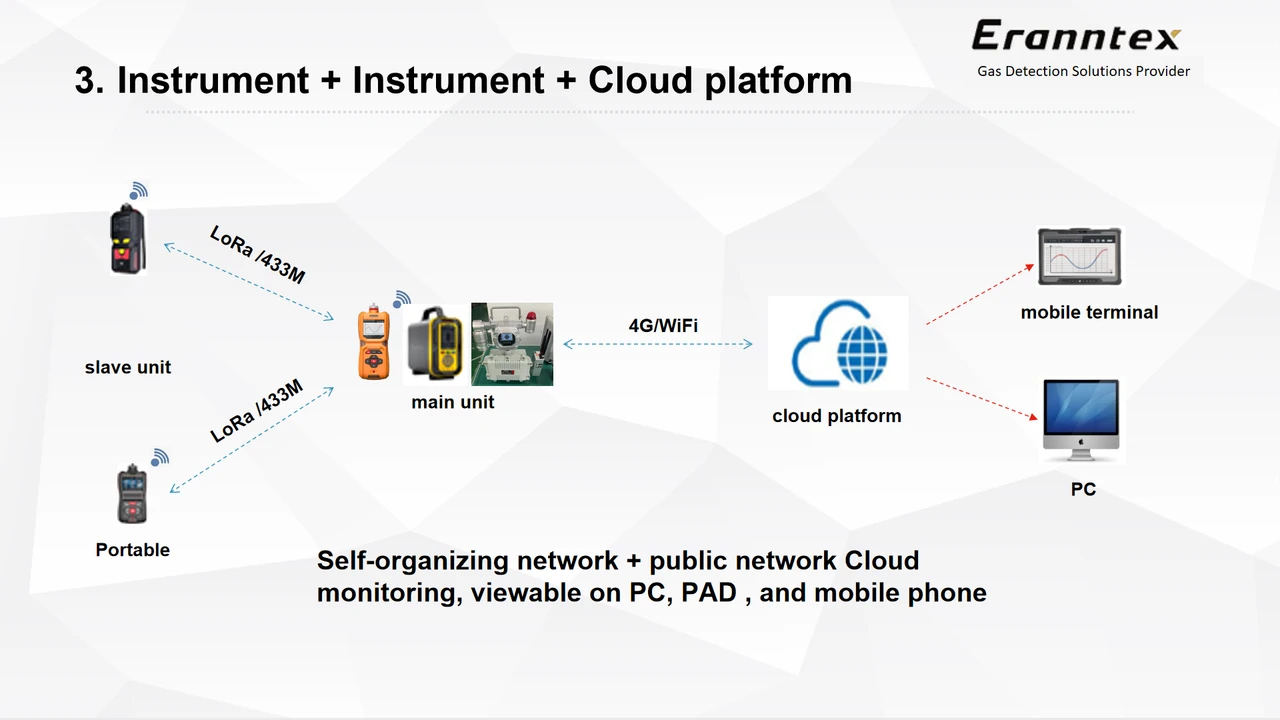
Wireless gas monitoring topology linking area detectors by LoRa or 433 MHz to a main unit and cloud platform over 4G or Wi-Fi

Monitoring challenge

Wireless coverage without signal cabling

Turnarounds, temporary maintenance zones, confined spaces and widely separated monitoring points can make permanent signal cabling slow or impractical. The monitoring architecture must still carry detector status and alarm information to the people coordinating the response.

A useful system must account for transmission distance, obstructions, public-network coverage, power availability and the way the field team will act on an alarm.


Area alarms and coordinated response

When one detector enters alarm, the event may need to be visible at other field instruments, a local host and a remote operations view. The response path should be defined for the operating area instead of treating every detector as an isolated device.

Solution method

Match the wireless topology to the site

Compatible instruments can be connected directly to a cloud platform through 4G or Wi-Fi, linked locally to a main unit through a suitable short- or long-range wireless network, or combined in a local self-organizing network with a public-network uplink.

Available communication methods depend on the selected equipment and project design. Protocol names are therefore treated as architecture options, not as universal features of every detector.

Unify local alarms and remote monitoring

The solution can combine local audible and visual warning with centralized device status, alarm records, trend review and map-based location information where compatible positioning and platform functions are configured.

Remote access can support distributed teams, while local storage and host functions preserve an on-site operational view.

Scale from a field group to a connected monitoring system

Portable instruments, area monitors, a local host and the Smart Cloud Monitoring Platform can be combined according to the deployment. Optional video, positioning and controller integration should be confirmed only when they are part of the selected project architecture.

Implementation guidance

Define the deployment before selecting communications

Document the target gases and ranges, monitoring points, portable or fixed equipment, required alarm sharing, transmission distances, obstructions, network coverage and whether remote platform access is required.

Also confirm local AC or DC power, battery-runtime expectations, installation conditions, positioning needs and the required alarm or data recipients. These inputs determine which topology and compatible devices can be proposed.

Design the warning path around the response plan

Define which events stay local, which alarms are repeated across field devices and which information is sent to the host or cloud platform. Notification contacts, escalation rules and data access should follow the customer's operating procedure.

Technical & Deployment FAQ

Review telemetry constraints, wireless communication selection and system integration requirements for the proposed monitoring network.