Four Factors That Decide the Choice
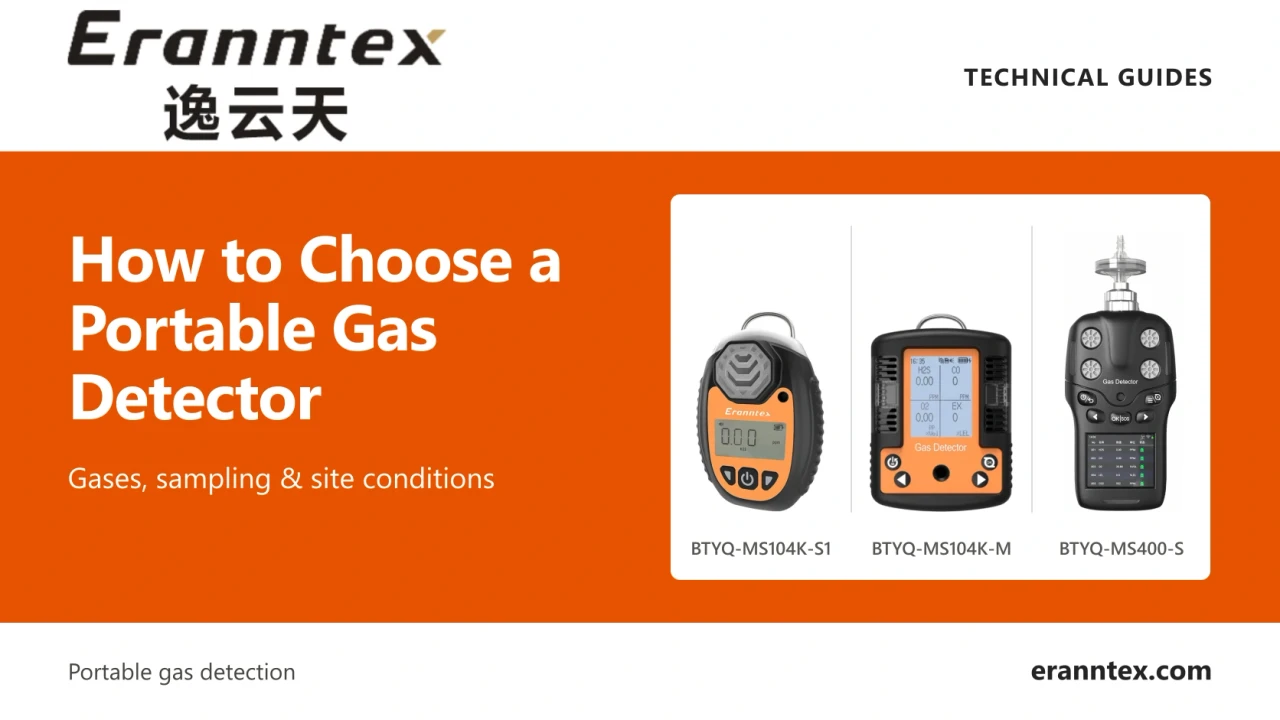
Matching an instrument to a facility requires balancing target gases, physical sensor operating limits, sampling mechanics, and environmental ratings. Eranntex manufactures standard instrument platforms and fits optional gas sensors and measuring ranges to each order, with the configuration confirmed by our engineers; factory visits to our Shenzhen site are welcome. Standard configurations are listed in our portable gas detector catalog.
Quick Decision Matrix: Matching Field Applications to Equipment
| Application Scenario | Target Atmospheric Hazards | Critical Sensing Factors & Constraints | Recommended Sampling Method | Primary Equipment Selection |
|---|---|---|---|---|
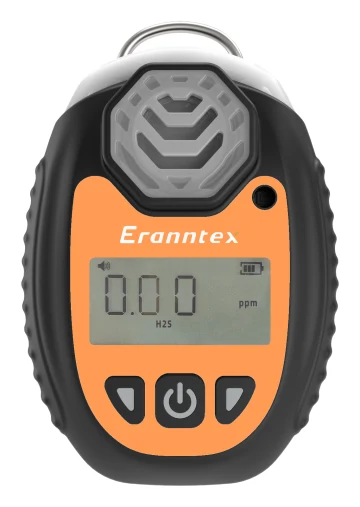
| Personal Breathing Zone Patrol | Dedicated single gas (H₂S, CO, O₂, etc.) | Shift-long personal protection without daily charging routines | Passive Diffusion | MS104K-S1 Single-Gas Detector (IP68, 1–2 yr battery working time) |
| Routine Confined Space Entry | Standard 4-Gas: %LEL, O₂, CO, H₂S | Atmospheric stratification; remote pre-entry check followed by personal wear | Diffusion with standard external pump, or switchable built-in pump | MS104K-M Multi-Gas Detector (IP66, opt. IP68) / MS400-S (IP68) |
| Inert Purging & Tank Clearance | Hydrocarbons in 0% O₂ (Nitrogen blanketing) | Catalytic bead failure in oxygen-depleted air; sensor roll-over at high concentrations | Motorized pump suction with an oxygen-independent sensor and a 0–100 %Vol range | MS400-S or MS600-S with a 0–100 %Vol range (sensing principle confirmed for each order) |
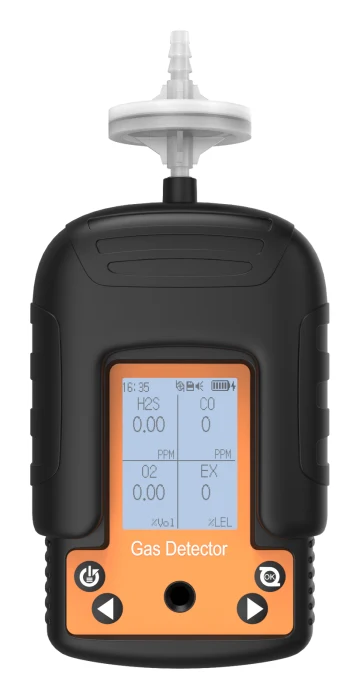
| Chemical & Process Surveys | Standard 4-Gas plus optional toxic gases or VOCs | Reactive gases adsorb onto standard rubber tubing; requires multi-sensor expansion | Motorized pump suction paired with PTFE-lined sampling lines | MS400-S Pumped Multi-Gas (1–4 gas standard, expandable to 6) |
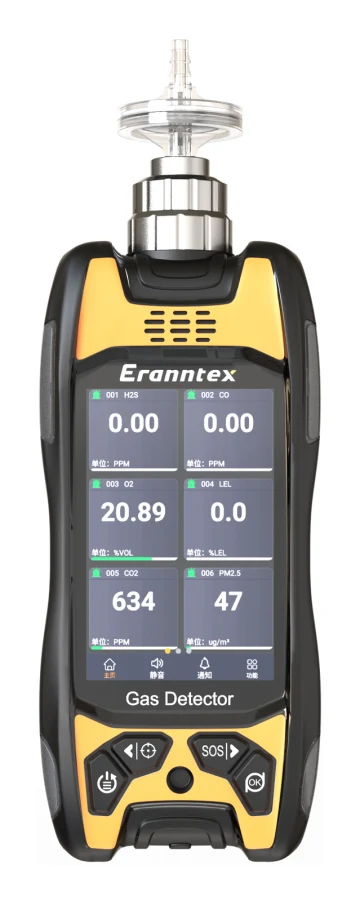
| High-Channel Industrial Audits | 1 to 7 gases (expandable to 8–9 channels) | Multiple toxic gases, volatile organics, and flammable vapors surveyed concurrently | Built-in motorized pump with touchscreen interface | MS600-S High-Capacity Multi-Gas (IP68, >24h pump runtime) |
1. Defining Atmospheric Hazards: Single-Gas vs. Multi-Gas Platforms
Gas detector selection starts with a site risk assessment: identify which gases can escape from process lines, storage vessels, or biological decomposition, and determine whether they appear individually or in complex mixtures.
On a past Eranntex project at a specialty chemical site, the gases were surveyed area by area before quoting. The order became four different gas sets on MS600-S portable detectors, each with its own gases and ranges, so no crew carried sensors its area did not need. [S5]
Dedicated Single-Gas Monitoring
Single-gas monitors provide compact coverage where workers face a specific, known hazard:
- Refinery and Drilling Units: Monitoring hydrogen sulfide (H₂S) release points around wellheads, crude manifolds, and desulfurization units.
- Boiler Rooms and Utilities: Tracking carbon monoxide (CO) exposure around industrial burners, furnaces, and flue ducting.
- Inert Storage and Cryogenics: Monitoring oxygen (O₂) deficiency around bulk liquid nitrogen, argon, or carbon dioxide tanks.
For these duties, the MS104K-S1 single-gas detector provides dedicated personal surveillance. Housed in an IP68 enclosure, it uses electrochemical or low-power infrared sensing principles matched to the target gas and measurement range. Powered by a 3.6 V, 1,600 mAh non-rechargeable battery, it operates for 1 to 2 years based on 8 hours of daily use, eliminating daily charging routines.
The Standard 4-Gas Baseline
For general utility maintenance and permit-required confined spaces, the industry baseline is a 4-gas monitor. To learn more about sensor configurations and target thresholds, review our guide on what a 4-gas monitor detects:
- Oxygen (O₂): Defending against oxygen deficiency (23.5% Vol).
- Combustible Gases (%LEL): Monitoring flammable vapors below their Lower Explosive Limit, with optional 0–100 %LEL and 0–100 %Vol ranges.
- Carbon Monoxide (CO): Tracking toxic byproducts of incomplete fuel combustion.
- Hydrogen Sulfide (H₂S): Monitoring sour gas releases and organic decomposition.
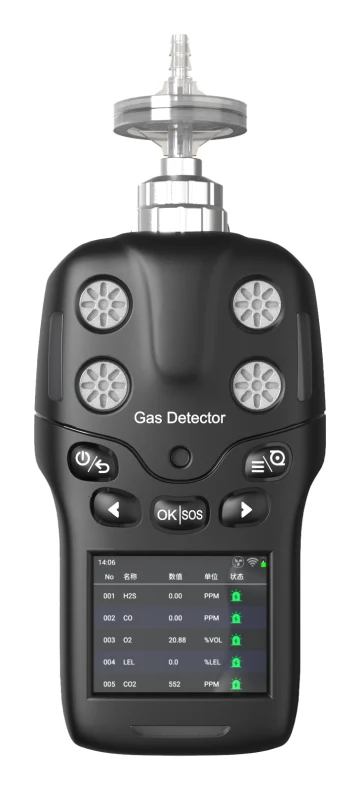
The MS104K-M multi-gas detector handles 1 to 4 gases as standard (expandable up to 6 gases). It operates in diffusion mode for personal wear and includes an external sampling pump as standard for pre-entry checks.
Expandable Multi-Gas Platforms
In chemical processing, solvent extraction, and industrial hygiene surveys, atmospheric threats often extend beyond four gases. Standard platforms like the MS400-S (1 to 4 gases standard, expandable to 6) and the MS600-S (1 to 7 gases standard, expandable to 8–9) can be fitted with optional gas sensors such as volatile organic compounds (VOCs), ammonia (NH₃), chlorine (Cl₂) and sulfur dioxide (SO₂). These are not standard fit; the sensor combination and measuring ranges are confirmed for each order.
On a past Eranntex power-plant project, the confined-space specification called for O₂, %LEL, H₂S, CO, SO₂ and NH₃ on one portable monitor. A standard four-gas unit could not cover it, so the system integrator chose a six-gas MS600-S, and tested a unit built the way it would ship, wireless module included, before ordering. [S5]
2. Sensor Operating Limits and Sampling Constraints
Overlooking a sensor's operating limits can result in false-safe readings in hazardous conditions.
Combustible Gas Detection: Catalytic Bead vs. Infrared Principles
Portable combustible gas detection relies primarily on catalytic bead (pellistor) or infrared sensors:
| Performance Characteristic | Catalytic Bead Sensor (Pellistor) | Infrared Sensor |
|---|---|---|
| Measurement Range | Up to 100 %LEL | %LEL and %Vol ranges, depending on the instrument configuration |
| Oxygen Requirement | Requires oxygen to sustain catalytic oxidation | Operates without oxygen; measures accurately in pure N₂ or Ar |
| High-Concentration Behavior | Subject to roll-over (can drop to 0% LEL in gas-rich atmospheres) | Linear across volume range; no roll-over effect |
| Poisoning Resistance | Vulnerable to poisoning by silicones, lead, and sulfur compounds | Not subject to catalytic sensor poisoning |
| Target Gas Scope | Measures most flammable gases and vapors, including hydrogen (H₂) | Measures hydrocarbon gases; cannot detect hydrogen (H₂) |
The Roll-Over Effect and Inerted Tank Hazards
Catalytic bead sensors rely on catalytic oxidation, which requires ambient oxygen. In an oxygen-deficient atmosphere or a fuel-rich release exceeding the Upper Explosive Limit (UEL, such as >15% methane by volume [S3]), oxygen is displaced from the active sensor bead. Deprived of oxygen, combustion stops: the instrument reading can spike past 100% LEL, roll over, and fall back toward 0% LEL. A technician seeing a 0% LEL reading might assume the space is safe, while in reality standing inside a fuel-rich atmosphere that becomes explosive as it mixes with fresh air.
Similarly, during plant turnaround maintenance, storage tanks and process vessels are purged with pure nitrogen (N₂) to remove flammable atmospheres. A catalytic bead detector inside an inerted vessel reads 0% LEL because there is no oxygen to support catalytic burning—even if the tank contains high concentrations of volatile hydrocarbons.
When measuring hydrocarbons in nitrogen-purged tanks, inerted process lines, or areas where concentrations can exceed the Lower Explosive Limit, specify an oxygen-independent sensor (such as infrared) with 0–100 %LEL and 0–100 %Vol ranges; the MS104K-M, MS400-S, and MS600-S offer both ranges. On a past Eranntex project for an environmental monitoring station, a single high-precision infrared sensor covered both the 0–100 %LEL and 0–100 %Vol combustible ranges on an MS600-S. That specification also listed more sensors than one instrument can hold, and the final configuration was agreed with the customer around the sensors that fit. [S5] Sensing principles depend on your chosen gas combination, so contact our engineering team to confirm the right setup for your site.
Gas Vapor Density and Elevation Profiling
A gas's vapor density relative to ambient air (air = 1.0) dictates where it collects in still air: [S2] [S3]
- Methane (Natural Gas, Vapor Density ~0.55): Lighter than air. Methane rises rapidly and collects under ceilings, roof structures, and overhead pockets.
- Carbon Monoxide (CO, Vapor Density ~0.97): Close to air density. CO mixes evenly throughout enclosed areas under typical air movement.
- Hydrogen Sulfide (H₂S) (Vapor Density ~1.19): Heavier than air. Toxic H₂S settles in floor sumps, low-lying trenches, and vessel bottoms.
- Propane / LPG (Vapor Density ~1.55): Substantially heavier than air. Vapors travel along drainage trenches and floor depressions toward potential ignition sources.
Tubing Wall Adsorption for Reactive Gases
When sampling polar, reactive, or corrosive gases, such as ammonia (NH₃), chlorine (Cl₂) or hydrogen chloride (HCl), sample tubing selection is critical.
Standard rubber or flexible PVC sample tubing causes reactive gas molecules to chemically adsorb onto inner tube walls. The gas never reaches the sensor chamber. The instrument displays a clean 0.0 ppm, giving technicians false clearance while the vessel holds dangerous gas concentrations.
When sampling for ammonia, chlorine, or other reactive gases, always use PTFE-lined (Teflon) or FEP (fluorinated ethylene propylene) sample tubing, and keep tubing runs as short as practical.
3. Sampling Method: Passive Diffusion vs. Motorized Pump-Suction
Diffusion Monitoring for Personal Protection
Diffusion detectors rely on natural air currents and gas dispersion to reach the sensor face:
- Personal Wear: Clipped to a worker's lapel or chest harness within the breathing zone (near the nose and mouth).
- Extended Runtime: Without motorized pump draw, battery runtime is substantially longer; model figures are listed under Battery Runtime Across Shifts below.
Diffusion detectors are the standard choice for continuous personal monitoring during plant patrol and daily work shifts. For details on personal monitoring practices, see our article on personal gas monitoring.
Motorized Sampling for Confined Space Pre-Entry
Never lower a passive diffusion detector into a confined space on a tether or rope. Lowering an instrument into a manhole prevents technicians from seeing display changes in real time, prevents controlled vertical profiling, and risks submerging the detector in sludge or water.
Pre-entry clearance testing requires active motorized sampling: the technician remains outside the space, drawing air through a probe and sampling hose directly into the instrument's sensor chamber. For detailed pre-entry procedures, see our guide on confined space entry.

Sampling Transit Delay
During remote pre-entry testing, the gas sample must travel through the probe and hose before reaching the sensor, so the total wait at each point is the hose transit delay plus the sensor's t90 response time. The MS104K-S1 has a t90 of ≤ 30 seconds; the MS104K-M, MS400-S, and MS600-S have a t90 of ≤ 20 seconds. When drawing air through extended sample lines, hold the probe stationary at each measurement point until the reading stabilizes before logging clearance. For draw-time recommendations with specific tubing lengths, contact our engineering team.
OSHA Confined Space Atmospheric Testing Rules
For permit-required confined spaces in the United States, OSHA regulations (29 CFR 1910.146) establish two distinct requirements. Other jurisdictions set their own rules.
- Required Testing Sequence (1910.146(d)(5)(iii)): Internal atmospheres must be tested in this specific order: [S1]
1. Oxygen content: Verify that oxygen is within safe limits. 2. Flammable gases and vapors: Verify that combustible vapors are below hazardous thresholds. 3. Potential toxic air contaminants: Verify that toxic gases (such as H₂S or CO) are within permissible exposure limits.
- Hazardous Atmosphere Criteria (1910.146(b), summarized): An atmosphere is hazardous if it may expose employees to death, incapacitation, injury or acute illness from one or more of the following: [S1]
- Oxygen concentration is below 19.5% Vol or above 23.5% Vol;
- Flammable gas, vapor, or mist exceeds 10% of its Lower Flammable Limit (LFL);
- Airborne combustible dust meets or exceeds its LFL;
- A substance could cause exposure above its published OSHA dose or permissible exposure limit;
- Any other atmospheric condition that is immediately dangerous to life or health (IDLH).
This sequence exists because catalytic combustible sensors require adequate oxygen to measure accurately, and explosive risks present an immediate threat to life.
4. Enclosure Ruggedness, Temperature, and Electrical Safety
Ingress Protection: IP66 vs. IP68
- IP66 Rating: The enclosure is dust-tight and protected against powerful water jets from any direction. Relevant where instruments face rain, spray or hose-down.
- IP68 Rating: The enclosure is dust-tight and protected against continuous submersion in water under depth and duration conditions specified by the manufacturer. Protects the enclosure if dropped into flooded pits, sumps, or trenches.
The MS104K-S1, MS400-S, and MS600-S are rated IP68. The MS104K-M is rated IP66 (with IP68 available as a custom configuration).
Battery Runtime Across Shifts
- MS104K-S1: 3.6 V, 1,600 mAh non-rechargeable battery providing 1 to 2 years of service at 8 hours per day.
- MS104K-M: Rechargeable 7.4 V, 1,400 mAh battery providing over 100 hours in diffusion operation (without catalytic, infrared, or photoionization (PID) sensors). Runtime with an external motorized pump depends on sensor configuration and pump draw.
- MS400-S: Rechargeable 7.4 V, 2,700 mAh battery providing over 20 hours in pump operation.
- MS600-S: Rechargeable 7.4 V, 3,450 mAh battery providing over 24 hours in pump operation.
Wireless and positioning options shorten these figures. On a past Eranntex utility project, an earlier MS600 model fitted with 4G, Wi-Fi and BeiDou positioning ran for about 6–8 hours on one charge with the pump, 4G and positioning all running. [S5] Current configurations differ, so ask our engineering team for the runtime of the configuration you plan to order.
Ambient Operating Temperatures
- MS104K-S1, MS104K-M, MS400-S: Operating temperature -20 °C to 55 °C.
- MS600-S: Operating temperature -10 °C to 55 °C.
Intrinsic Safety Marking
All four Eranntex portable models carry an intrinsic safety marking: Ex ia IIC T4 Ga The marking is shown on each product page. Equipment with an EPL Ga rating is suitable for Zone 0, Zone 1, and Zone 2 hazardous locations; Zone 0 is a place where an explosive gas atmosphere is present continuously, for long periods or frequently. [S6] Confirm that the certificate covers your model and configuration and is accepted under your facility's local compliance rules.
5. Maintenance: Bump Testing, Calibration, and Modular Sensors
Functional Bump Testing vs. Full Span Calibration
- Functional Bump Test: A brief challenge check with a known gas concentration to verify that sensors respond and audible, visual, and vibrating alarms activate. Bump test frequency should follow the manufacturer's instruction manual and site safety protocols.
- Full Span Calibration: An analytical adjustment against certified calibration gas. Calibration should be performed at scheduled intervals specified in the instruction manual, or whenever an instrument fails a functional bump test.
Modular Digital Sensor Architectures
The MS400-S uses plug-in digital sensor modules, and the MS600-S has a modular digital sensing architecture.
Eranntex Portable Gas Detector Comparison Guide
| Feature / Model | MS104K-S1 | MS104K-M | MS400-S | MS600-S |
|---|---|---|---|---|
| Channel Capacity | 1 gas dedicated | 1–4 gases (expandable to 6) | 1–4 gases (expandable to 6) | 1–7 gases (expandable to 8–9) |
| Sampling Mechanism | Passive Diffusion | Diffusion; external pump supplied as standard | Built-in pump; switchable to diffusion | Built-in motorized pump |
| Ingress Protection | IP68 | IP66 (IP68 optional) | IP68 | IP68 |
| Weight | Approx. 200 g | Approx. 200 g (about 300 g with the external pump) | Approx. 430 g | Approx. 500 g |
| Battery & Runtime | 3.6 V, 1,600 mAh (1–2 yrs at 8h/day, non-rechargeable) | 7.4 V, 1,400 mAh (>100h diffusion runtime*) | 7.4 V, 2,700 mAh (>20h pump operation) | 7.4 V, 3,450 mAh (>24h pump operation) |
| Display | 1.7-inch display | 2.0-inch display | 2.4-inch color display | 3.5-inch IPS touchscreen |
| Sensor Response (t90) | ≤ 30 seconds | ≤ 20 seconds | ≤ 20 seconds | ≤ 20 seconds |
| Intrinsic Safety Marking | Ex ia IIC T4 Ga | Ex ia IIC T4 Ga | Ex ia IIC T4 Ga | Ex ia IIC T4 Ga |
| Combustible Ranges | 0–100 %LEL | 0–100 %LEL and 0–100 %Vol | 0–100 %LEL and 0–100 %Vol | 0–100 %LEL and 0–100 %Vol |
| Operating Temperature | -20 °C to 55 °C | -20 °C to 55 °C | -20 °C to 55 °C | -10 °C to 55 °C |
\MS104K-M diffusion runtime applies without catalytic, infrared, or PID sensors installed. Gas combinations and measurement ranges are confirmed for each order.* [S4]
Request a Quote
When requesting an equipment recommendation or quotation, prepare the following application details:
- Target Gas List: All gases to be monitored along with required measurement ranges and alarm setpoints.
- Sampling Protocol: Whether detectors will be used primarily for breathing zone personal monitoring (diffusion) or pre-entry clearance testing (motorized pump suction).
- Environmental Severity: Ambient temperature boundaries (confirming whether -20 °C performance is required or if the -10 °C rating of the MS600-S is suitable) and water ingress conditions (IP66 vs. IP68).
- Sampling Accessories: The sampling accessories you already use or need, such as probe length, filters, or sample tubing for reactive gases.
Contact our engineering team to discuss your gas monitoring requirements or request an equipment quotation.
Sources
| No. | Source | Used for |
|---|---|---|
| S1 | OSHA 29 CFR 1910.146, Permit-required confined spaces | Hazardous atmosphere criteria in paragraph (b); testing order in (d)(5)(iii) |
| S2 | NIOSH Pocket Guide to Chemical Hazards: carbon monoxide, hydrogen sulfide, propane | Relative gas density: CO 0.97, H₂S 1.19, propane 1.55 |
| S3 | NOAA CAMEO Chemicals: Methane | Methane vapor density 0.55; upper explosive limit 15 % |
| S4 | Eranntex product pages: MS104K-S1, MS104K-M, MS400-S, MS600-S | Gas configurations, sampling, IP rating, weight, battery and runtime conditions, display, t90, Ex marking, combustible ranges, operating temperature |
| S5 | Eranntex project records (anonymized) | The past-project examples in sections 1, 2 and 4 |
| S6 | UK HSE: Explosive atmospheres – classification of hazardous areas (zoning) and selection of equipment | Definition of Zone 0 |